Demolition and Strip-Out: What to Know Before the First Blow
Stripping Tiles and Render
Part 2 of 4
In most homes, demolition isn't about walls but about surfaces: tiles, render, old bathroom fittings, kitchen units and floors. It is the first step in almost every bathroom or kitchen renovation, and it decides how sound the base will be for everything that follows.
How deep?
Not every job needs stripping back to the brick. If the tiles are holding, don't sound hollow when you tap them lightly and there are no leaks, a room can sometimes be refreshed without being stripped out completely. But when the pipes or the layout are changing, or the tiles are coming loose, the safer course is for everything to go.
In the bathroom with the green bathtub, the tiles, the bathtub and the old render came off until the brick showed. In one kitchen, the render above the tiles had already started to flake, and there too the walls went back to the brick before the new kitchen went in.
The order of the work
A strip-out usually follows these steps:
- The water and power are shut off where the work will be.
- The fittings, the bathtub or the units come out, and any pipes left open are capped.
- The wall tiles come off, together with the adhesive or mortar behind them.
- The render comes off where it is hollow, damp, or where the wall has to be opened for new pipes.
- If the floor is changing too, its tiles and the bed under them are taken up.
- The room is cleared so you can see clearly what is left underneath.
What the strip-out reveals
In a small bathroom, the bathtub was built into a front panel of bricks and tiles. Once the panel was broken out, the rust on the body of the bathtub and the worn wall behind it came into view.
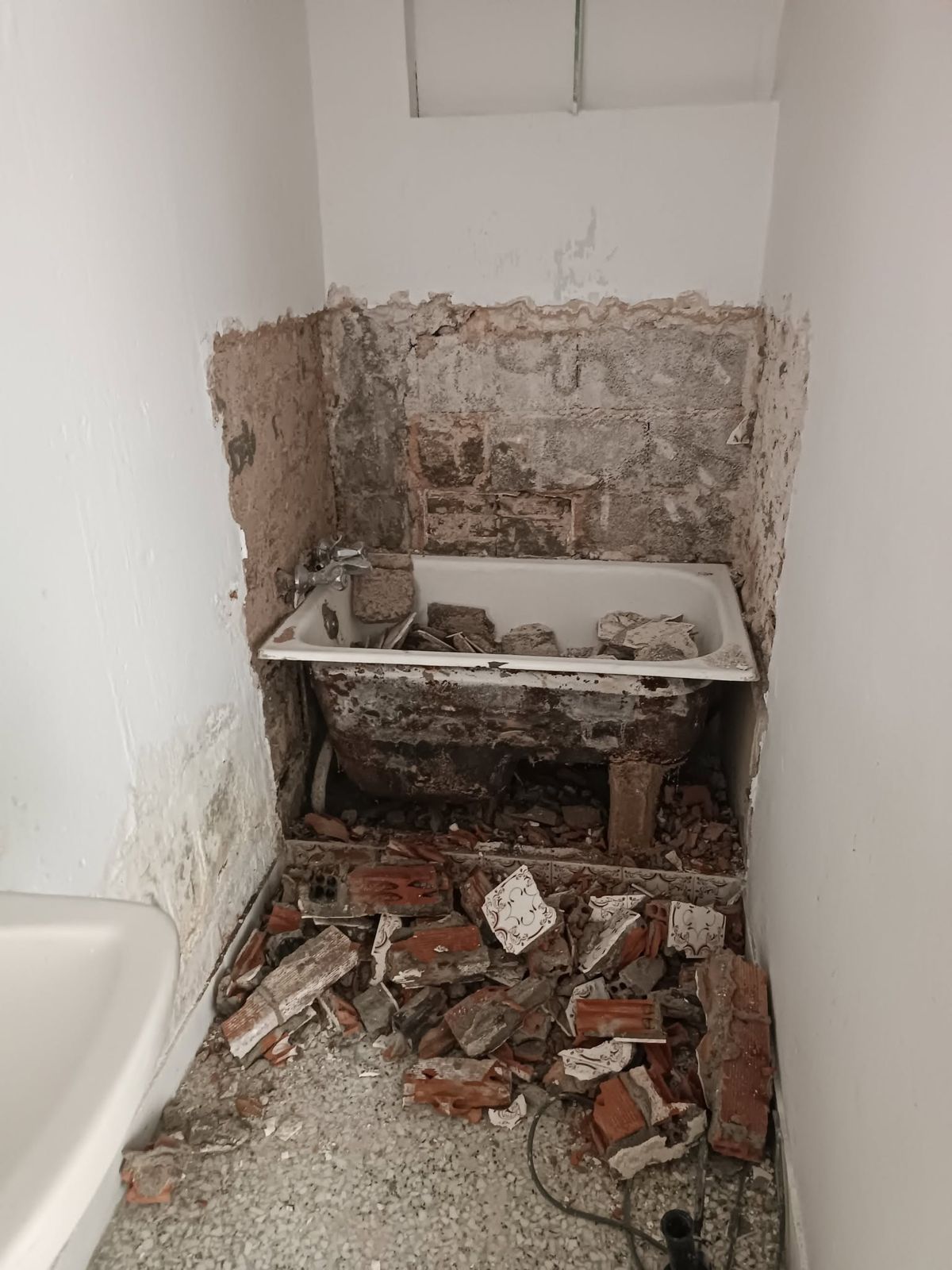
This happens often: the real picture only shows once the walls and floors are open. There may be worn-out old pipes, damp, crumbling render or rusted steel where there is concrete. That is why it helps to agree beforehand what happens if something unexpected turns up.
Care for what stays
Stripping out isn't only breaking things. The wall you share with the next room, the tiles of the neighbouring room, the pipes that stay and the floor's waterproofing, where there is one, all have to stay intact. Very heavy blows on thin walls can crack the plaster on the other side.
Keep in mind
- Stripping tiles and render doesn't touch columns, beams or slabs.
- Ask how far the strip-out will go, and why.
- If you want to keep something, such as a piece of furniture or a tap, say so before the work starts.