Demolition and Strip-Out: What to Know Before the First Blow
Rubble, and What to Ask
Part 4 of 4
Rubble is the part of demolition that most people underestimate. Broken tiles, chunks of render, bricks, old adhesive and screed take up far more room than you'd expect, and even a small bathroom fills a lot of bags.
From the room to the street
The rubble is bagged inside the work area as the strip-out goes on, so it doesn't spread through the rest of the home. In one flat where the old floor was taken up, the bags were filled right next to where the tiles were being broken up.
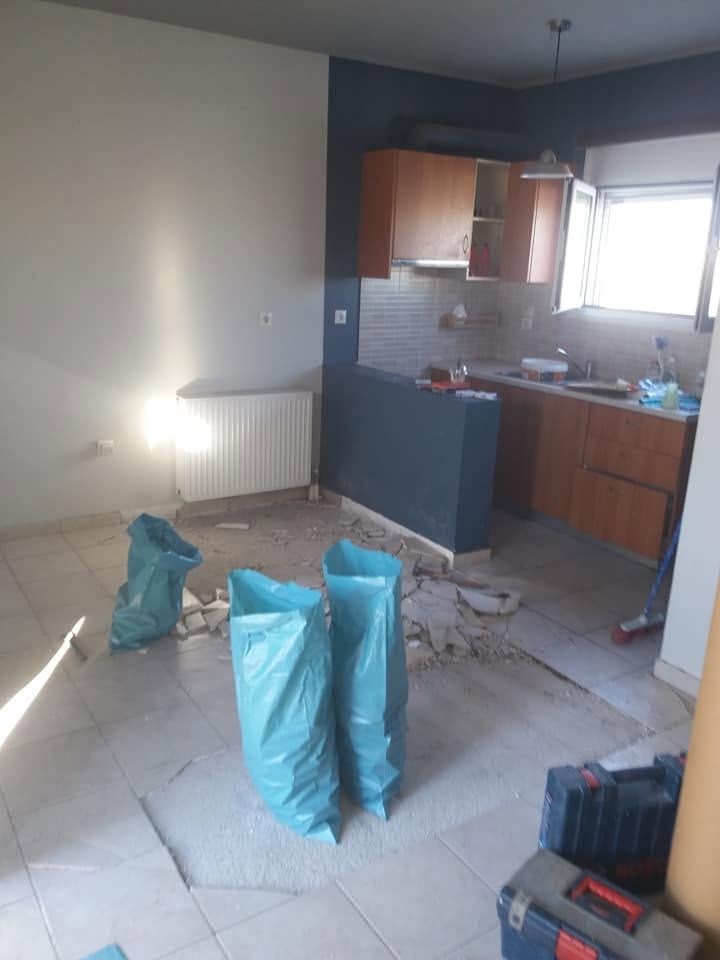
In a block of flats, the bags go down the stairs or in the lift, with the shared areas protected, and are never thrown from balconies. From there they are loaded onto a small truck or into a skip. Putting a skip on the street or pavement usually needs a permit from the municipality.
Where it ends up
Rubble doesn't go in household bins or onto empty plots. Waste from building work has to end up with a licensed waste management scheme. It is reasonable to ask who will take it away, where it will go and whether its removal is included in the quote.
After the strip-out
Once the rubble is gone and the room is clean, the base shows clearly: bare brick, concrete, old pipes. That is the moment to check what was found and settle the plan. In the bathroom with the green bathtub, the strip-out was followed by new pipes, a floor sloped toward the drain, render and finally the tiles.
What to ask before it starts
- Is any of the walls being worked on load-bearing? Who has checked?
- Does this job need an engineer or a permit?
- What exactly will be removed, and how deep?
- Do pipes or cables run through the parts being broken out? Who will shut them off and move them?
- How will the other rooms and the shared areas be protected?
- Which days will be the noisiest?
- Who takes the rubble, where does it go, and is that included in the quote?
- What happens if something unexpected turns up behind the walls or under the floor?
With these answers in hand, demolition becomes an organised first step rather than an unpleasant surprise.