Spray Polyurethane Foam: Flat Roofs, Metal Roofs and Pilotis Ceilings
Protecting the Foam, and What to Ask
Part 4 of 4
Foam insulates and closes the way to water, but it has one weak point: the sun. What goes on top of it matters as much as the spraying itself.
Why it isn't left bare
The sun's ultraviolet light yellows the foam and slowly wears it away. Outdoors it is therefore always covered, and it's best to do this without a long delay after spraying.
The options seen in the jobs
- A white protective coating. On a bare roof and on metal roofs it was rolled over the foam until no spot was left uncovered. The white reflects the sun, so the space below heats up less.
- A liquid membrane. On a roof with torn membranes, a white liquid polyurethane membrane went over the foam, waterproofing it and shielding it from the sun. It wrapped the air conditioning stands and chimneys on every side.
- Tar and a screed. On a bare slab, the foam got a coat of tar and then a new screed brought up by pump, levelled with a straightedge so no hollows were left. Here the screed protects the insulation and gives a hard surface to walk on.
- Paint on an indoor ceiling. In one room the foam on the ceiling was painted white. The ceiling kept a soft, textured finish.
- Render on walls. On the outside walls of a house under construction, render goes over the foam to protect it and give the final finish.
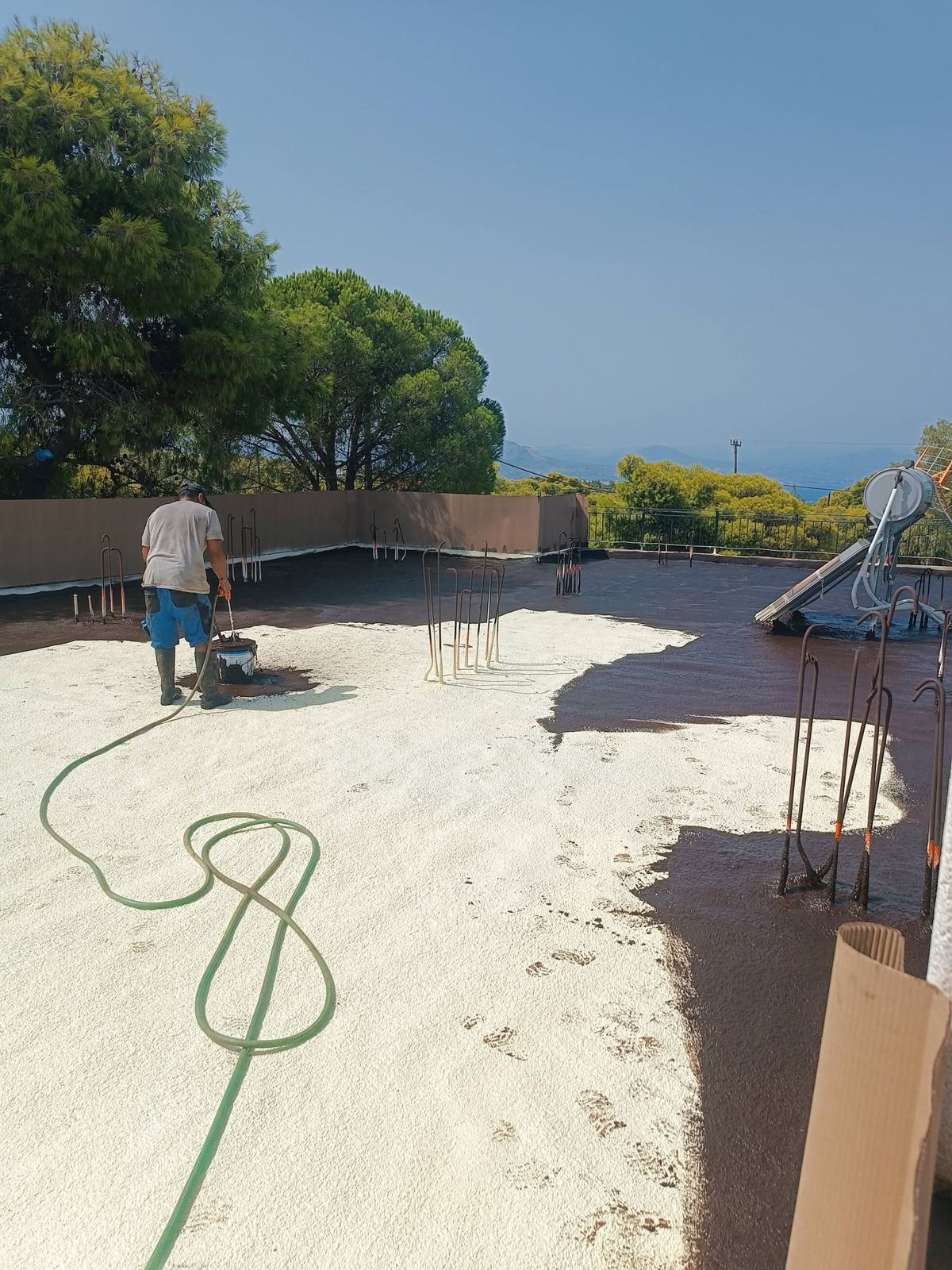
Which option suits depends on whether the roof will be walked on, what equipment stands on it, and how much height the thresholds and parapets allow.
Maintenance
The coating over the foam wears with time, faster where it is walked on or where water pools. Take a look at the roof every so often, and certainly after a hot summer or a heavy storm. Look for spots where the foam shows through again, for cracking around bases and for blocked drains. A small worn patch can be recoated locally before it grows. Don't drag heavy or sharp objects across the surface.
What to ask before the work starts
- What happens to the old materials: are they stripped or left underneath?
- Do the falls need correcting, or is a new screed needed?
- Will a primer go on, and where?
- How thick will the foam layer be, and will it go up the parapets?
- What will cover it, and when?
- How will the drains, thresholds and equipment bases be handled?
- What needs to be covered or moved, and who in the building needs to be told?
The answers depend on your roof, so they come after someone has inspected it.