Damp and Fire-Damaged Rooms: The Work Before the Paint
Reading the Damage
Part 1 of 5
A room that has been through damp or a fire looks as if it just needs a coat of paint. In practice, painting is the last and smallest part of the job. Before anything else, it's worth reading what the damage tells you: where it is, what it looks like and where it might be coming from.
Where the damage is
The position of the damage gives the first clue to its cause.
- Low on the walls, above the skirting. Bubbling paint, crumbling plaster and flakes on the floor often point to moisture from below, such as rising damp, or to a leaking pipe. In a shop unit, scraping showed clearly how far up the wall the damp had reached.
- Around and below windows. Water getting in at the frame or through the outside wall, or condensation on cold surfaces. In an office, the paint had lifted around and below the window.
- On the ceiling. Usually water from above: a roof, a balcony, a bathroom on the floor above, or a pipe. In one apartment a whole section of ceiling plaster had come down.
- Around pipes. Behind a water heater the plaster had crumbled around the pipes, and in another home the ceiling around the water heater pipe had turned black.
- In corners, high on walls and around windows, as black spots. This is mould, which usually points to condensation. It appears where the wall is coldest, for example at thermal bridges.
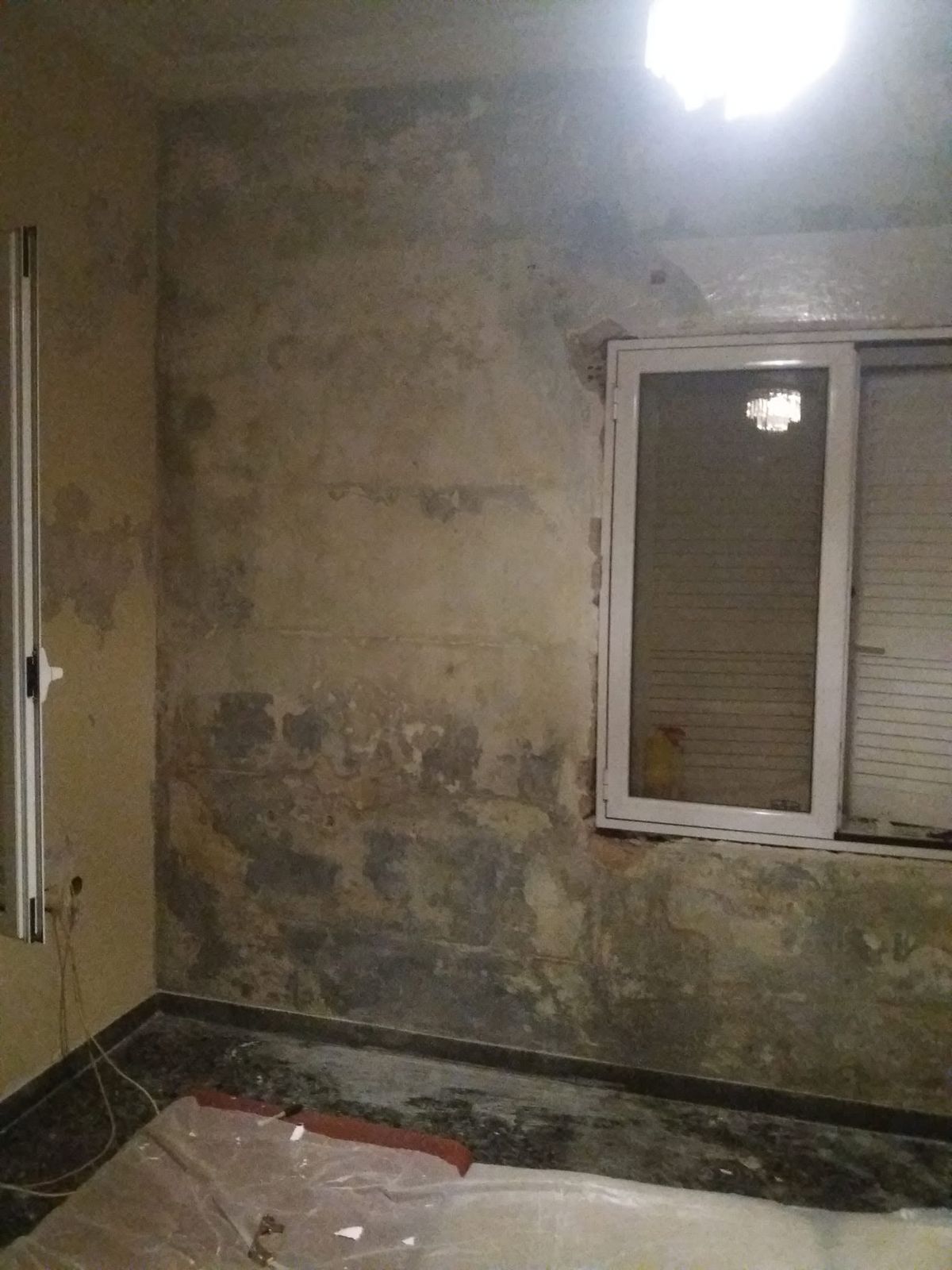
In this flat the walls were covered in dark stains from top to bottom, and the old paint was coming away in whole sheets.
A white crust on the surface
A white crust on the wall, hard or fluffy, is salts carried by water through the masonry. As the water evaporates, the salts stay on the surface or just behind the paint and push it off. It's a sign that water is passing through the wall, not just sitting on it.
After a fire
Soot is the most visible problem, but not the only one. Heat loosens plaster and paint and can crack surfaces. The work after a fire has its own chapter in this guide.
The cause comes first
Scraping, plaster and a good paint job fix the surface, not the cause. If the water is coming from the roof, a leak or the ground, that has to be dealt with first or at the same time, or the damage will come back in the same place. A leaking pipe needs a plumber, a roof needs waterproofing, and condensation needs better ventilation or insulation on the cold surfaces.
Which cause applies in a particular home can only be judged on site. Often there is more than one.