Courtyards, Sidewalks and Balconies: A Guide to Outdoor Floors
Concrete Sidewalks and Walkways
Part 3 of 4
When a sidewalk or a garden path has broken along its whole length, patching rarely gives a good result. The new pieces stand out, and the old ones around them keep failing. One option then is to relay the whole stretch in concrete: one continuous surface, with no slabs rocking and no gaps for weeds.
Concrete or slabs?
Concrete goes down as one single surface, follows awkward shapes and manhole covers easily, and doesn't have lots of joints that can open up. On the other hand it looks plainer, and when it cracks, the crack shows. Slabs and stone look warmer and can be repaired piece by piece, but their joints need looking after. The choice depends on how the space is used, the style of the house and, for a sidewalk, on what the municipality requires.
The steps
- Clearing. Weeds, moss and anything loose or crumbling come out, so the new concrete sits on a sound base.
- Levels and falls. Before the concrete is poured, it's decided where the water will run, usually towards the street or a drain, and how the new surface will meet the kerb, the wall and the entrances.
- Pouring and levelling. The concrete is spread along the whole length and levelled with a straightedge. Around manhole covers the surface has to come up to the same height, so no step is left. Depending on thickness and use, steel mesh may also go into the concrete.
- Protection and curing. Fresh concrete has to be kept off while it sets, and it's best if it doesn't dry out too fast in the sun, because then it cracks more easily.
- Finishing. Once it has dried properly, the surface can be left as it is or painted.
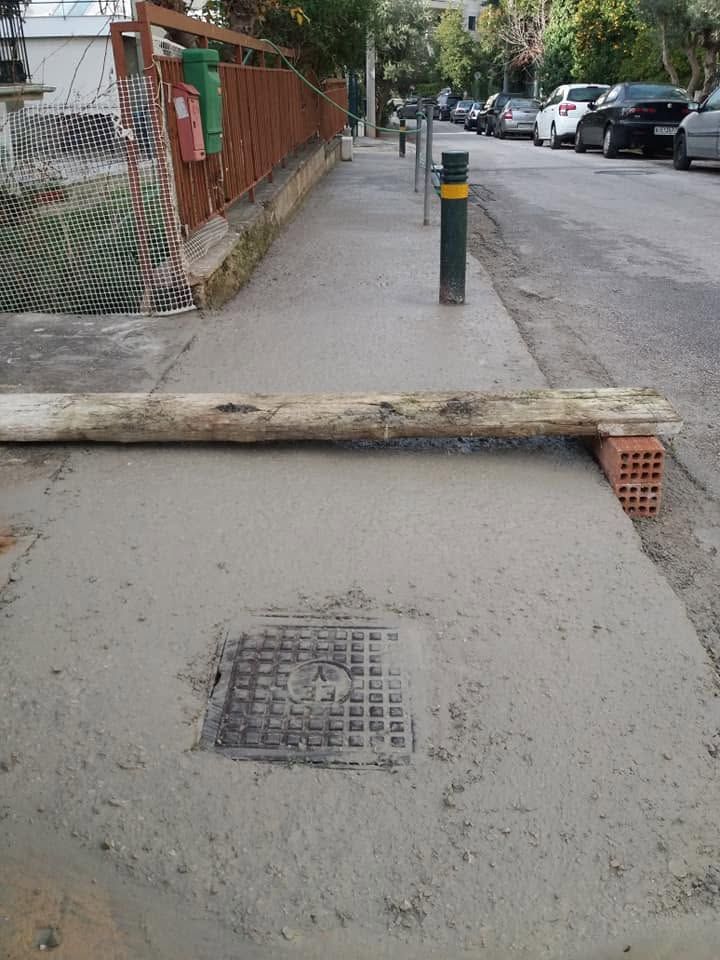
On one sidewalk covered in moss and broken pieces, new concrete was laid from the kerb to the wall and around the manhole cover. A board resting on bricks blocked the way while the concrete set, so nobody would step on it. Once it had dried, the surface was painted grey and the base of the wall white, and the sidewalk became one clean, continuous stretch along its whole length.
Painting
Paint gives an even look and hides the difference in shade between new and old concrete. But it's a thin layer that wears under foot traffic, so at some point it needs renewing. Ask whether the paint is made for outdoor floors and whether it's slip-resistant, because a smooth painted surface can be slippery when wet.
Before you start
The sidewalk in front of the house is a public space. In many municipalities work on it needs a permit or has to follow set specifications for materials, colours and levels. It's worth asking your municipality before the work starts.
Take care with the utility covers too (water, electricity, telephone). They must stay clear, flush with the surface, and able to open.
What to ask
- Will the old floor be broken up and removed, or will the concrete go on top of it?
- Which way will the water run?
- How will the fresh concrete be protected, and when can it be walked on?
- What paint will be used, and is it slippery when wet?